

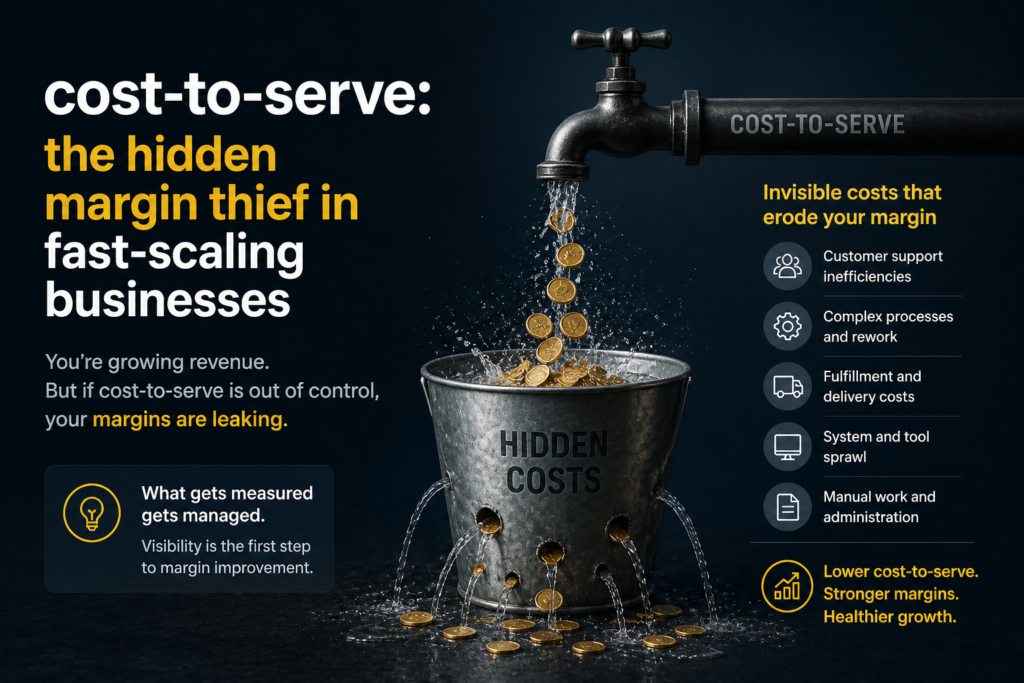
Fast-growing businesses share a common blind spot: they know their revenue by customer, by product, and by channel. They often know their gross margin by product. But very few know their cost-to-serve — the total cost of acquiring, serving, and retaining each customer segment at a granular level.
This blind spot is where margin goes to die.
What cost-to-serve actually measures
Cost-to-serve is the complete cost of delivering your product or service to a specific customer or customer segment, beyond the cost of the product itself. It includes order complexity, delivery frequency, service demands, payment terms, returns and credits, sales and account management time, custom packaging, compliance requirements, and every other resource the customer consumes.
Two customers buying the same product at the same price can have radically different profitability once cost-to-serve is factored in. One orders in bulk, pays on time, and never calls support. The other orders in small quantities, demands customised invoicing, pays 60 days late, and escalates every issue to senior management. The first is highly profitable. The second may be loss-making.
But without cost-to-serve visibility, both appear equally valuable on the revenue report.
Why it matters for growth
As businesses scale, cost-to-serve complexity compounds. New customer segments bring new service requirements. New channels have different fulfilment costs. International expansion adds logistics, compliance, and currency complexity. What was a minor inefficiency at 100 customers becomes a structural margin drain at 1,000.
The most dangerous scenario is when a business is growing revenue rapidly while its overall margin is declining slowly. The declining margin is invisible in the aggregate data because revenue growth masks it. By the time it becomes visible, the structural cost-to-serve problems are embedded in the operating model and much harder to fix.
Building cost-to-serve visibility
The solution is not to stop serving high-cost customers. It is to understand the cost, price accordingly, and design the service model to manage it. Some customers justify high cost-to-serve because they pay commensurately. Others need to be migrated to lower-cost service models. And some — the honest truth — should be managed out of the portfolio because they consume more value than they create.
Cost-to-serve analysis is a core discipline within Profit Maximisation in the Nuraya Growth System. We build the models, quantify the gaps, and design the pricing and service architecture that ensures every customer segment generates margin — not just revenue.
If your business is growing but your margins are not, the answer is almost certainly hidden in your cost-to-serve.
Share