

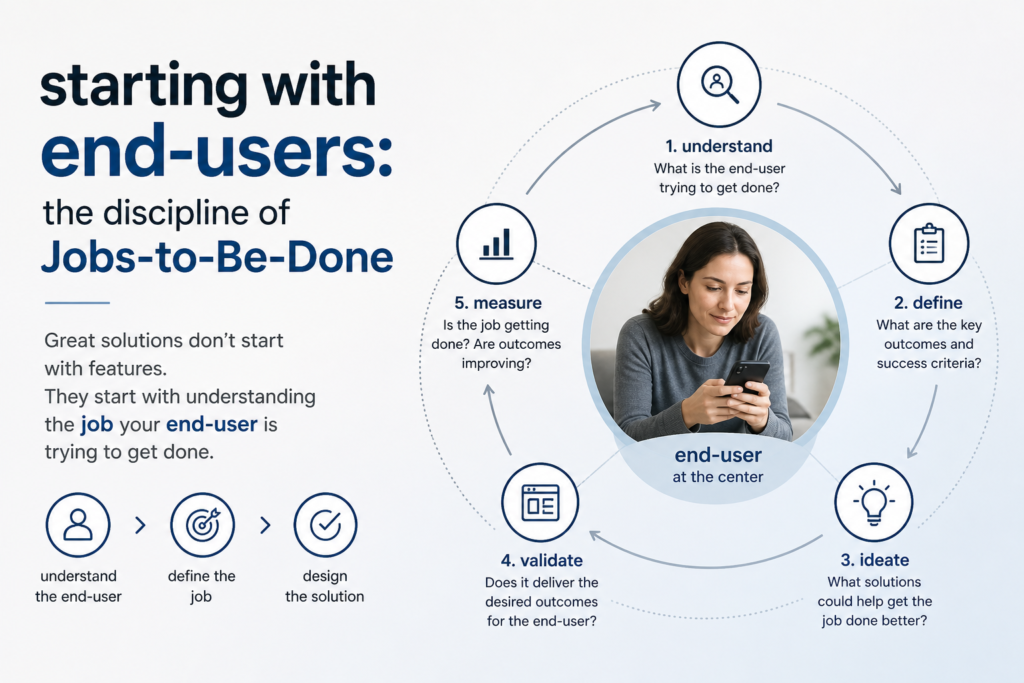
The single most reliable foundation for a growth strategy is a deep understanding of what your end-users are actually trying to accomplish. Not what they say they want. Not what your product does. What they are trying to get done in their lives or their businesses — and what is getting in the way.
This is the core insight behind Jobs-to-Be-Done, a framework developed by Clayton Christensen and refined by practitioners across industries. It is deceptively simple: people do not buy products. They hire products to do a job. And when you understand the job, everything about your strategy becomes clearer.
Why most market research misses the point
Traditional market research asks the wrong questions. It asks customers what they think of your product, how satisfied they are, what features they want. This data feels actionable but is actually misleading, because it anchors the conversation around what you already sell rather than what the customer is actually trying to achieve.
A business that sells drills does not compete with other drill manufacturers. It competes with every other solution to the job of “I need to make a hole in my wall.” That reframing opens up entirely different strategic possibilities — different competitive sets, different value propositions, different innovation paths.
How to apply Jobs-to-Be-Done
The discipline starts with research — but not the survey-based, quantitative kind. It starts with deep qualitative investigation: interviewing customers about the circumstances that led them to seek a solution, the alternatives they considered, the trade-offs they made, and the outcomes they are still unsatisfied with.
From these interviews, patterns emerge. Jobs can be mapped, prioritised, and sized. Underserved jobs reveal growth opportunities. Overserved jobs reveal commoditisation risk. And the emotional and social dimensions of the job — not just the functional — reveal the positioning that will actually resonate.
From insight to strategy
Jobs-to-Be-Done is not an academic exercise. It is the starting point for Revenue Growth strategy within the Nuraya Growth System. It informs brand positioning, portfolio architecture, pricing, go-to-market design, and communication strategy. When you know the job, you know who to target, what to build, how to price it, and where to sell it.
The discipline of starting with end-users — genuinely starting there, not retro-fitting customer language onto decisions already made — is what separates businesses that grow because they are relevant from businesses that grow until they are not.
Share