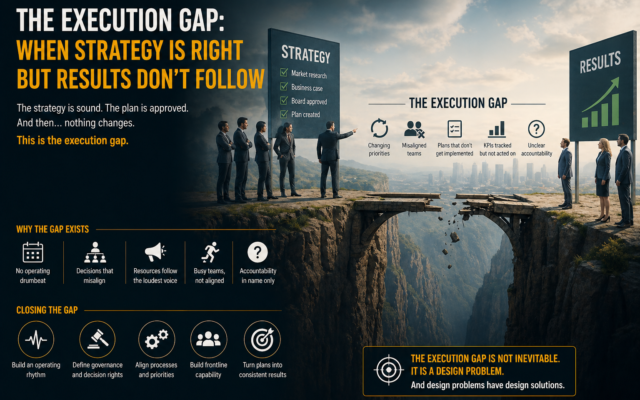



There is a principle in organisational design that is uncomfortable to hear but impossible to argue with: every organisation is perfectly designed for the results it currently delivers. If you do not like the results, the problem is not effort — it is design.
This principle, articulated by Arthur Jones and later popularised by organisational theorists, applies universally. The business delivering inconsistent results has inconsistent systems. The business with siloed functions has a structure that rewards silos. The business struggling to retain talent has a culture, compensation structure, or leadership approach that drives talent away.
None of this is accidental. It is the output of design choices — some made deliberately, many made by default.
The design choices that shape results
Four elements define how an organisation operates: structure, processes, people, and culture. Most leadership teams focus on one or two and neglect the rest.
Structure determines who reports to whom, how decisions get made, and how resources are allocated. A structure designed for a 50-person company will constrain a 200-person company. A structure optimised for one market will resist expansion into three markets. Structure is not neutral — it either enables or prevents the results you want.
Processes define how work gets done — how plans are made, how information flows, how performance is reviewed, how decisions are escalated. In most businesses, processes evolve organically rather than being designed. The result is a patchwork of workarounds, informal channels, and institutional habits that nobody questions because “that is how we have always done it.”
People capabilities — not headcount but actual capability — determine what the organisation can execute. A strategy that requires sophisticated pricing governance will fail if nobody in the organisation knows how to build or maintain a pricing architecture. Hiring alone does not solve this; building capability does.
Culture is the hardest to see and the most powerful. It is the set of unwritten rules that determine what behaviour is actually rewarded, what is tolerated, and what is punished. Culture is not what the values poster says. Culture is what happens when the boss is not in the room.
Redesigning for the results you want
If the current organisation is perfectly designed for its current results, then getting different results requires redesigning the organisation. Not restructuring — that is usually just moving boxes on a chart. Redesigning means working through all four elements: adjusting structure to match strategy, building processes that enable execution, developing the capabilities the strategy demands, and shaping a culture that reinforces the right behaviours.
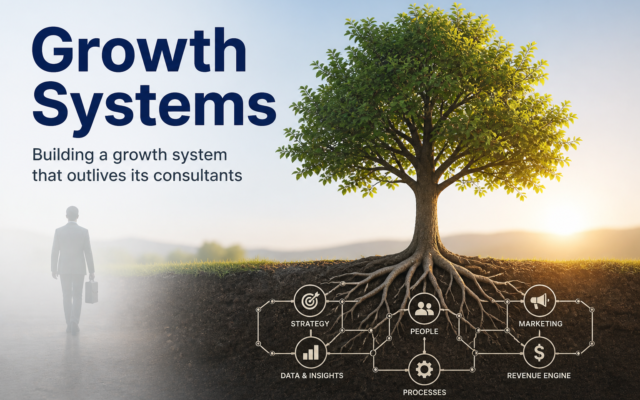
This is the work of Leadership & Organisation within the Nuraya Growth System. We help businesses design the organisation that their growth ambition demands — not the one they inherited or the one that feels comfortable, but the one that will actually deliver the results they want.
The question is not whether your organisation is well designed. It is perfectly designed — for whatever it is currently delivering. The question is whether those are the results you want.
Share