


Most businesses treat profit as a residual — whatever is left over after revenue comes in and costs go out. This is backwards. Profit is not something that happens to a business. It is something a business designs.
The companies that consistently deliver strong margins do not do so by accident. They make deliberate choices about pricing, about which customers to serve and which to walk away from, about how to structure their cost base, and about where to invest and where to cut. They treat margin as a system, not a line on a P&L.
Where margin actually comes from
Margin is created in the intersection of three things: what you charge, what it costs you to deliver, and how efficiently you convert revenue into cash. Most businesses focus on the first two and ignore the third. Many do not even measure cost-to-serve at a meaningful level of granularity.
The result is a common paradox: the business is growing, the team is working harder than ever, but profitability is flat or declining. Revenue is going up, but margin is being quietly eroded by unpriced complexity — customers who demand more service, channels that cost more to serve, products that require more support, promotions that discount faster than they acquire.
The disciplines that protect margin
Protecting and growing margin requires a set of disciplines that most businesses know about but few practise consistently. Pricing governance — the ability to maintain and enforce pricing architecture across markets, channels, and customer segments — is the most powerful margin lever available, and the most commonly neglected.
Unit economics — understanding the true profitability of each product, customer, and channel at a granular level — is the diagnostic that reveals where margin is being created and where it is being destroyed. Without it, businesses make portfolio decisions based on revenue, not profit, and unknowingly subsidise unprofitable growth with profitable growth.
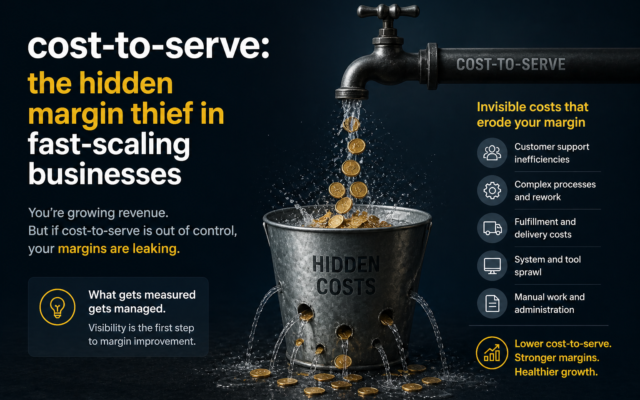
Cost-to-serve analysis — quantifying the true cost of serving each customer segment — reveals the hidden margin thieves that aggregate data obscures. A customer who buys in high volume but demands bespoke service, expedited delivery, and extended payment terms may generate significant revenue but destroy margin at scale.
Designing the profit system
Profit Maximisation within the Nuraya Growth System is built on these disciplines. We bring diagnostic rigour to margin analysis, build pricing governance frameworks, develop unit economics models, and design cost-to-serve visibility that turns margin from a hope into a managed outcome.
The shift is fundamental: from treating profit as what is left over, to treating it as the system you build. Every business can make this shift. The ones that do consistently outperform their peers — not by 5 or 10 percent, but by multiples, sustained over years.
Share